

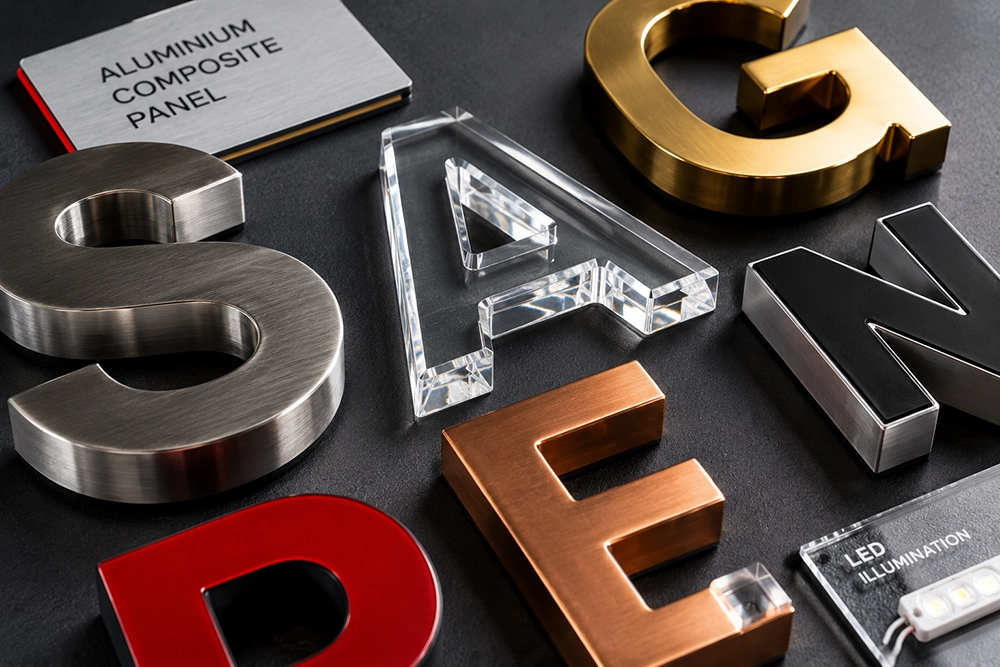
Material choice affects far more than appearance. It influences weight, depth, lighting, durability, maintenance and installation. Acrylic, aluminium composite panel and stainless steel can all produce excellent signage, but each solves a different set of requirements.
Begin with the installation environment
Indoor signs face different conditions from external façades. Outdoor specifications must account for UV exposure, heat, moisture, wind, dust and the condition of the supporting surface.
Also consider how close visitors will be to the sign. Materials and finishes that look excellent from a distance may reveal joints or surface variation at close range.
Acrylic: versatile and ideal for illumination
Acrylic is widely used for faces, built-up letters, lightboxes, displays and internal identification signs. It is available in many colours and can be routed, laser cut, bent, bonded and printed.
Opal acrylic diffuses LED light across a sign face. Clear acrylic can support printed graphics or dimensional elements. Thickness, colour consistency and edge finishing should match the intended construction.
ACP: practical for panels and façades
Aluminium composite panel provides a flat, lightweight surface for sign backgrounds, shopfront fascias, cladding and printed graphics. It is easier to handle than solid metal sheets at larger sizes.
ACP quality, coating and core specification should suit the application. Edge treatment, joints and supporting frames are especially important when panels are viewed closely or exposed outdoors.
Stainless steel: premium finish and durability
Stainless steel is commonly selected for built-up letters, logos, plaques and architectural signage. Brushed, mirror, painted and titanium-coated finishes can create a refined appearance.
Grade selection, fabrication quality, weld finishing and maintenance all affect long-term performance. Coastal or demanding locations may require a more suitable grade and cleaning plan.
The strongest signs often combine materials
A single sign may use stainless-steel returns, acrylic faces, aluminium backs, LED modules and an ACP support panel. The correct combination balances appearance, structure, serviceability and cost.
Ask for a material specification and physical samples where finish is critical. This makes approval clearer and reduces differences between expectation and production.